
• My Account
    • Log In
    • This content is only available to Thetius subscribers đź”’
  • Contact Us
Thetius
  • Free Content
    • Free Newsletter
    • Free Reports
    • Free Webinars
  • Markets
    • By Industry
      • Ship Operations and Management
        • Maritime Autonomous Surface Ships (MASS)
        • Environmental Management (Vessels)
        • Technical Fleet Management
        • Vessel Performance Optimisation
        • Decarbonisation (Vessels)
      • Chartering and Voyage Management
        • Chartering and Commercial Operations
        • Voyage Management
        • Market Intelligence
        • Risk Management and Marine Insurance
        • Trade Facilitation
        • Emissions Monitoring and Reporting
      • Port and Terminal Management
        • Terminal Operating Systems
        • Environmental Management (Ports)
        • Port Cargo Handling
        • Environmental Management (Ports)
        • Asset Management (Ports)
        • Port Call Management
        • Decarbonisation (Ports)
    • By Technology
      • Artificial Intelligence
      • Satellite Communications
      • Digital Platforms
      • Alternative Power Sources
      • Data and Analytics
      • Internet of Things
      • Carbon Capture and Storage Systems
      • Electronic Documentation
      • Robotics
      • Digital Twin
      • Cyber Security
      • Blockchain
      • Process Automation
      • Simulation
  • Research Services
    • IT Cost, Innovation, and Performance Benchmarking Club
    • Thought Leadership
    • Market Assessment
    • Customer Feedback
    • Competitor Analysis
    • Technology Strategy Workshops
    • Subscription Research
  • Upcoming Events
  • About us
    • About us
    • Careers
  • Get In Touch
  • Free Content
    • Free Newsletter
    • Free Reports
    • Free Webinars
  • Markets
    • By Industry
      • Ship Operations and Management
        • Maritime Autonomous Surface Ships (MASS)
        • Environmental Management (Vessels)
        • Technical Fleet Management
        • Vessel Performance Optimisation
        • Decarbonisation (Vessels)
      • Chartering and Voyage Management
        • Chartering and Commercial Operations
        • Voyage Management
        • Market Intelligence
        • Risk Management and Marine Insurance
        • Trade Facilitation
        • Emissions Monitoring and Reporting
      • Port and Terminal Management
        • Terminal Operating Systems
        • Environmental Management (Ports)
        • Port Cargo Handling
        • Environmental Management (Ports)
        • Asset Management (Ports)
        • Port Call Management
        • Decarbonisation (Ports)
    • By Technology
      • Artificial Intelligence
      • Satellite Communications
      • Digital Platforms
      • Alternative Power Sources
      • Data and Analytics
      • Internet of Things
      • Carbon Capture and Storage Systems
      • Electronic Documentation
      • Robotics
      • Digital Twin
      • Cyber Security
      • Blockchain
      • Process Automation
      • Simulation
  • Research Services
    • IT Cost, Innovation, and Performance Benchmarking Club
    • Thought Leadership
    • Market Assessment
    • Customer Feedback
    • Competitor Analysis
    • Technology Strategy Workshops
    • Subscription Research
  • Upcoming Events
  • About us
    • About us
    • Careers
  • Get In Touch
Thetius
Thetius
No Result
View All Result

How Unverified Efficiency Claims Lead to Capital Misallocation in Shipping

Matt Stevens by Matt Stevens
May 6, 2026
in Free Content
0
How Unverified Efficiency Claims Lead to Capital Misallocation in Shipping

Investment in fuel-efficiency technologies is an essential part of shipping’s path toward decarbonisation. However, investment decisions become far more difficult when performance claims are uncertain or overstated. This insight explores how unverified fuel-saving claims can lead to capital misallocation, with shipowners potentially investing in solutions that fail to deliver the expected benefits while more effective innovations struggle to gain traction.

When claims are not independently verified, owners may invest in technologies that are not well-suited to their business, wasting capital on solutions that don’t deliver promised savings.

For smaller owners in particular, one failed investment can discourage further experimentation. As one interviewee told us, “A single failed investment for a small owner can represent a major part of their annual budget and discourage them from trying new solutions in the future, making them more sceptical.”

With many software providers chasing the business of a limited number of commercial vessels, investor returns are reducing, and the maritime technology market is heading for consolidation. This environment makes it harder for a single product to grow and mature, increasing the likelihood of the same providers dominating the technology landscape.

Operational fragmentation further complicates the picture. Cargo ships, passenger ships, and offshore vessels all operate in different ways, and even within the same category the variation is huge.

For example, cargo ships may switch between tramp trades and long-haul liner routes, or between time-charter and spot employment. Passenger vessels range from tightly scheduled ferries to cruise ships with highly variable hotel loads.

Every vessel is also uniquely designed and operated under specific commercial conditions. This means that operational behaviour is the product of vessel type, ship design, trading pattern, commercial constraints, and crew behaviour.

Voyage optimisation technologies must therefore cope with a fragmented operational landscape, one where generic models rarely fit and where optimisation must be tailored to each vessel and use case.

However, data, models, weather inputs, standards, and even user behaviour are quite often inconsistent and disconnected, making it even more difficult to prove results and build trust.

This can foster a defensive mindset in which each party depends solely on its own data and definitions, eroding industry cohesion.

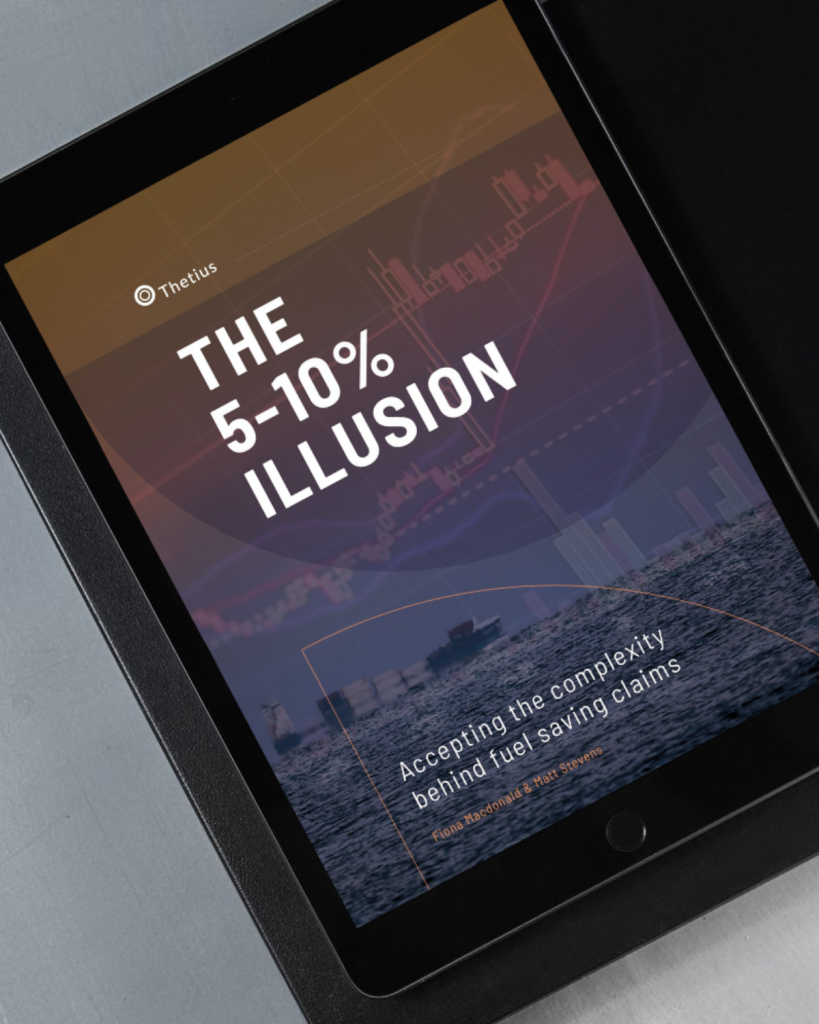
Download ‘The 5-10% Illusion’  and explore why the maritime industry’s reliance on unverified efficiency claims is eroding trust, and discover a framework to restore measurement discipline.
Tags: 5-10% Illusion
Previous Post

From Vision to Implementation – Strengthening Digital Foundations in Practice

Next Post

Information Overload in Shipping: The Challenge of Using Data Effectively

Next Post
Information Overload in Shipping: The Challenge of Using Data Effectively

Information Overload in Shipping: The Challenge of Using Data Effectively

  • Client Login
  • Terms of Use
  • Privacy Policy

© 2026 Thetius is an Antares Digital Group Company

No Result
View All Result
  • Free Content
    • Free Newsletter
    • Free Reports
    • Free Webinars
  • Markets
    • By Industry
      • Ship Operations and Management
      • Chartering and Voyage Management
      • Port and Terminal Management
    • By Technology
      • Artificial Intelligence
      • Satellite Communications
      • Digital Platforms
      • Alternative Power Sources
      • Data and Analytics
      • Internet of Things
      • Carbon Capture and Storage Systems
      • Electronic Documentation
      • Robotics
      • Digital Twin
      • Cyber Security
      • Blockchain
      • Process Automation
      • Simulation
  • Research Services
    • IT Cost, Innovation, and Performance Benchmarking Club
    • Thought Leadership
    • Market Assessment
    • Customer Feedback
    • Competitor Analysis
    • Technology Strategy Workshops
    • Subscription Research
  • Upcoming Events
  • About us
    • About us
    • Careers
  • Get In Touch

© 2026 Thetius is an Antares Digital Group Company

We use cookies to ensure that we give you the best experience on our website. If you continue to use this site we will assume that you are happy with it.