
• My Account
    • Log In
    • This content is only available to Thetius subscribers 🔒
  • Contact Us
Thetius
  • Free Content
    • Free Newsletter
    • Free Reports
    • Free Webinars
  • Markets
    • By Industry
      • Ship Operations and Management
        • Maritime Autonomous Surface Ships (MASS)
        • Environmental Management (Vessels)
        • Technical Fleet Management
        • Vessel Performance Optimisation
        • Decarbonisation (Vessels)
      • Chartering and Voyage Management
        • Chartering and Commercial Operations
        • Voyage Management
        • Market Intelligence
        • Risk Management and Marine Insurance
        • Trade Facilitation
        • Emissions Monitoring and Reporting
      • Port and Terminal Management
        • Terminal Operating Systems
        • Environmental Management (Ports)
        • Port Cargo Handling
        • Environmental Management (Ports)
        • Asset Management (Ports)
        • Port Call Management
        • Decarbonisation (Ports)
    • By Technology
      • Artificial Intelligence
      • Satellite Communications
      • Digital Platforms
      • Alternative Power Sources
      • Data and Analytics
      • Internet of Things
      • Carbon Capture and Storage Systems
      • Electronic Documentation
      • Robotics
      • Digital Twin
      • Cyber Security
      • Blockchain
      • Process Automation
      • Simulation
  • Research Services
    • IT Cost, Innovation, and Performance Benchmarking Club
    • Thought Leadership
    • Market Assessment
    • Customer Feedback
    • Competitor Analysis
    • Technology Strategy Workshops
    • Subscription Research
  • Upcoming Events
  • About us
    • About us
    • Careers
  • Get In Touch
  • Free Content
    • Free Newsletter
    • Free Reports
    • Free Webinars
  • Markets
    • By Industry
      • Ship Operations and Management
        • Maritime Autonomous Surface Ships (MASS)
        • Environmental Management (Vessels)
        • Technical Fleet Management
        • Vessel Performance Optimisation
        • Decarbonisation (Vessels)
      • Chartering and Voyage Management
        • Chartering and Commercial Operations
        • Voyage Management
        • Market Intelligence
        • Risk Management and Marine Insurance
        • Trade Facilitation
        • Emissions Monitoring and Reporting
      • Port and Terminal Management
        • Terminal Operating Systems
        • Environmental Management (Ports)
        • Port Cargo Handling
        • Environmental Management (Ports)
        • Asset Management (Ports)
        • Port Call Management
        • Decarbonisation (Ports)
    • By Technology
      • Artificial Intelligence
      • Satellite Communications
      • Digital Platforms
      • Alternative Power Sources
      • Data and Analytics
      • Internet of Things
      • Carbon Capture and Storage Systems
      • Electronic Documentation
      • Robotics
      • Digital Twin
      • Cyber Security
      • Blockchain
      • Process Automation
      • Simulation
  • Research Services
    • IT Cost, Innovation, and Performance Benchmarking Club
    • Thought Leadership
    • Market Assessment
    • Customer Feedback
    • Competitor Analysis
    • Technology Strategy Workshops
    • Subscription Research
  • Upcoming Events
  • About us
    • About us
    • Careers
  • Get In Touch
Thetius
Thetius
No Result
View All Result

The “5–10% Fuel Savings” Problem in Shipping: Why Many Claims Lack Proof

Matt Stevens by Matt Stevens
March 18, 2026
in Free Content
0
The “5–10% Fuel Savings” Problem in Shipping: Why Many Claims Lack Proof

Claims of 5–10% fuel savings are now a familiar feature of maritime technology marketing. For shipowners facing rising fuel costs and tightening emissions regulations, even marginal efficiency gains can translate into meaningful financial and environmental benefits. This insight introduces what the report calls the “5–10% problem”, the growing credibility gap created by repeated efficiency claims that are difficult to verify in real-world operations. As the same headline numbers continue to appear across the market, many operators are beginning to question whether these savings can truly be proven.

Many fuel-saving technologies for ships claim efficiency gains in the 5-10% range. This is an appealing figure as it’s just plausible enough to be believable and significant enough to promise worthwhile savings. As a result, it has become a common marketing benchmark.

But over time, this repeated reliance on 5-10% claims has created a credibility problem. Shipowners and charterers increasingly question whether such improvements can truly be achieved in real-world operations. They hear the same number from many vendors, so often, and with so little transparent evidence, that it has lost its persuasive power. As one stakeholder interviewed for this report noted, “I hear 5-10% fuel savings so often that I no longer believe any of them.”

This erosion of trust has wider implications. Instead of accelerating the adoption of new efficiency technologies, unverified claims have fuelled scepticism, slowed investment, and hindered the industry’s broader decarbonisation ambitions. Without credible, comparable evidence of performance, decision-makers struggle to separate genuine innovations from over-optimistic marketing.

As Haris Zografakis, a Maritime Lawyer at Stephenson Harwood in London explained, “Decarbonisation isn’t only about the energy transition. It’s also about energy efficiency and reducing emissions today, not just in 50 years’ time. To do that credibly, we must be able to measure what we save and prove it.”

Across the shipping industry, claims of achieving 5-10% in fuel savings are widely stated. But obtaining credible proof is a challenge and rarely part of the story.

While efficiency gains of a few percentage points can deliver substantial cost and emissions reductions, most 5-10% claims are based on short, vendor-led trials, selective reporting, or modelling that may not reflect all real operating conditions. The result is a credibility gap. Shipowners no longer trust the numbers and genuinely effective solutions struggle to stand out. Moreover, capital ends up misallocated in a fragmented, opaque market.

This report diagnoses three main drivers of this problem. The first is the commercial and regulatory pressure that encourages vendors to overstate benefits while keeping methods vague. The second is cultural reluctance to share performance data, which limits independent scrutiny and learning. Third is the complex technical reality. Bespoke ships, variable operations, imperfect sensors, inconsistent baselines, and standards such as ISO 19030 that were not designed for today’s high-frequency, data-rich environments make sub-10% gains difficult and costly to measure with confidence.

The purpose of this research is to introduce the 5–10% problem and the implications it has for the shipping industry, examine why accurately proving small efficiency gains remains so difficult, and provide a framework and recommendations to help the industry better understand, verify, and trust stated fuel-saving results.

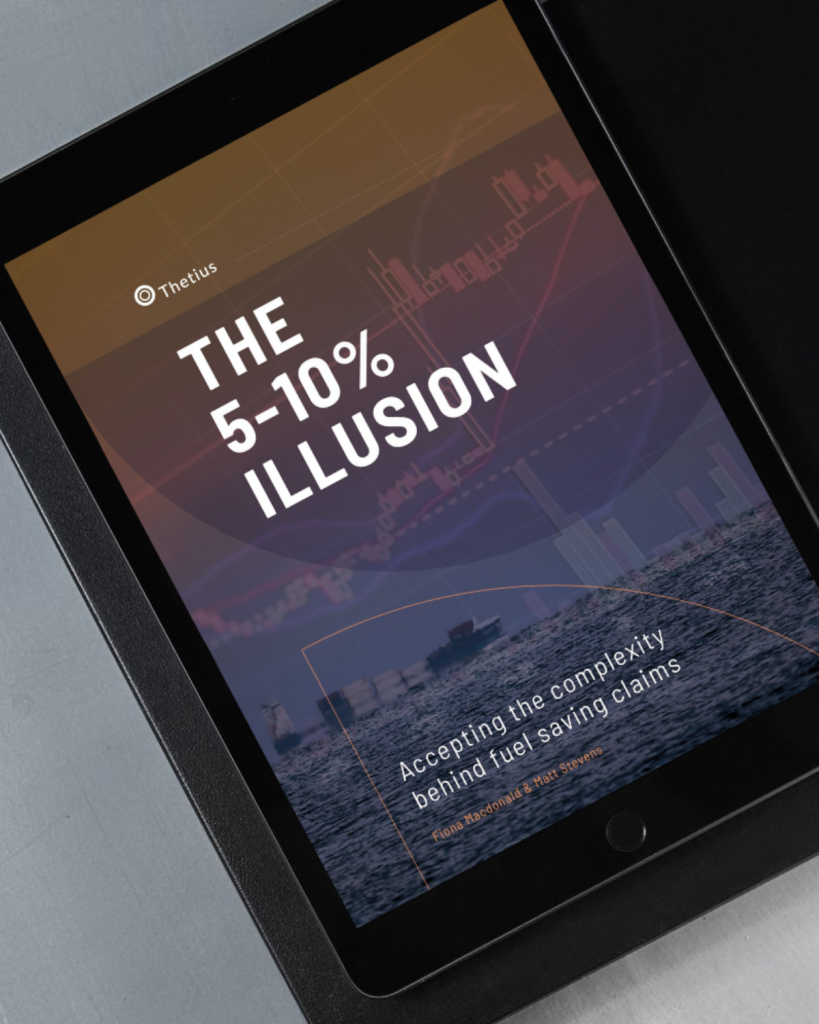
Download ‘The 5-10% Illusion’  and explore why the maritime industry’s reliance on unverified efficiency claims is eroding trust, and discover a framework to restore measurement discipline.
Tags: 5-10% Illusion
Previous Post

The Cost of Fragmented Tools and Email-Driven Workflows

Next Post

What a Successful Human–AI Balance Looks Like in Practice

Next Post
What a Successful Human–AI Balance Looks Like in Practice

What a Successful Human–AI Balance Looks Like in Practice

  • Client Login
  • Terms of Use
  • Privacy Policy

© 2026 Thetius is an Antares Digital Group Company

No Result
View All Result
  • Free Content
    • Free Newsletter
    • Free Reports
    • Free Webinars
  • Markets
    • By Industry
      • Ship Operations and Management
      • Chartering and Voyage Management
      • Port and Terminal Management
    • By Technology
      • Artificial Intelligence
      • Satellite Communications
      • Digital Platforms
      • Alternative Power Sources
      • Data and Analytics
      • Internet of Things
      • Carbon Capture and Storage Systems
      • Electronic Documentation
      • Robotics
      • Digital Twin
      • Cyber Security
      • Blockchain
      • Process Automation
      • Simulation
  • Research Services
    • IT Cost, Innovation, and Performance Benchmarking Club
    • Thought Leadership
    • Market Assessment
    • Customer Feedback
    • Competitor Analysis
    • Technology Strategy Workshops
    • Subscription Research
  • Upcoming Events
  • About us
    • About us
    • Careers
  • Get In Touch

© 2026 Thetius is an Antares Digital Group Company

We use cookies to ensure that we give you the best experience on our website. If you continue to use this site we will assume that you are happy with it.