
• My Account
    • Log In
    • This content is only available to Thetius subscribers 🔒
  • Contact Us
Thetius
  • Free Content
    • Free Newsletter
    • Free Reports
    • Free Webinars
  • Markets
    • By Industry
      • Ship Operations and Management
        • Maritime Autonomous Surface Ships (MASS)
        • Environmental Management (Vessels)
        • Technical Fleet Management
        • Vessel Performance Optimisation
        • Decarbonisation (Vessels)
      • Chartering and Voyage Management
        • Chartering and Commercial Operations
        • Voyage Management
        • Market Intelligence
        • Risk Management and Marine Insurance
        • Trade Facilitation
        • Emissions Monitoring and Reporting
      • Port and Terminal Management
        • Terminal Operating Systems
        • Environmental Management (Ports)
        • Port Cargo Handling
        • Environmental Management (Ports)
        • Asset Management (Ports)
        • Port Call Management
        • Decarbonisation (Ports)
    • By Technology
      • Artificial Intelligence
      • Satellite Communications
      • Digital Platforms
      • Alternative Power Sources
      • Data and Analytics
      • Internet of Things
      • Carbon Capture and Storage Systems
      • Electronic Documentation
      • Robotics
      • Digital Twin
      • Cyber Security
      • Blockchain
      • Process Automation
      • Simulation
  • Research Services
    • IT Cost, Innovation, and Performance Benchmarking Club
    • Thought Leadership
    • Market Assessment
    • Customer Feedback
    • Competitor Analysis
    • Technology Strategy Workshops
    • Subscription Research
  • Upcoming Events
  • About us
    • About us
    • Careers
  • Get In Touch
  • Free Content
    • Free Newsletter
    • Free Reports
    • Free Webinars
  • Markets
    • By Industry
      • Ship Operations and Management
        • Maritime Autonomous Surface Ships (MASS)
        • Environmental Management (Vessels)
        • Technical Fleet Management
        • Vessel Performance Optimisation
        • Decarbonisation (Vessels)
      • Chartering and Voyage Management
        • Chartering and Commercial Operations
        • Voyage Management
        • Market Intelligence
        • Risk Management and Marine Insurance
        • Trade Facilitation
        • Emissions Monitoring and Reporting
      • Port and Terminal Management
        • Terminal Operating Systems
        • Environmental Management (Ports)
        • Port Cargo Handling
        • Environmental Management (Ports)
        • Asset Management (Ports)
        • Port Call Management
        • Decarbonisation (Ports)
    • By Technology
      • Artificial Intelligence
      • Satellite Communications
      • Digital Platforms
      • Alternative Power Sources
      • Data and Analytics
      • Internet of Things
      • Carbon Capture and Storage Systems
      • Electronic Documentation
      • Robotics
      • Digital Twin
      • Cyber Security
      • Blockchain
      • Process Automation
      • Simulation
  • Research Services
    • IT Cost, Innovation, and Performance Benchmarking Club
    • Thought Leadership
    • Market Assessment
    • Customer Feedback
    • Competitor Analysis
    • Technology Strategy Workshops
    • Subscription Research
  • Upcoming Events
  • About us
    • About us
    • Careers
  • Get In Touch
Thetius
Thetius
No Result
View All Result

The Credibility Gap in Maritime Fuel-Saving Claims

Matt Stevens by Matt Stevens
April 29, 2026
in Free Content
0
The Credibility Gap in Maritime Fuel-Saving Claims

Trust plays a critical role in the adoption of new maritime technologies. When shipowners cannot easily verify performance claims, confidence in those technologies can quickly erode. Across the industry, repeated promises of 5–10% fuel savings have begun to generate scepticism among operators and charterers. This insight looks at how exaggerated or poorly substantiated efficiency claims contribute to a growing credibility gap in the maritime sector.

Marketing hype has already begun to erode trust around energy-saving claims. As Peter Mantel, CCO of Theyr, explained, “You’re always hearing companies offering 5% or 10% savings. Some even go higher, 15% or 20%. It’s led to scepticism in the industry because quite often these claims could never be quantified.”

This widens the credibility gap. Even vendors with genuinely effective solutions struggle to win trust in a market saturated with exaggerated promises. As a result, some technologies that could deliver meaningful benefits are ignored, not because they lack value, but because their claims are no longer believed.

The credibility gap not only slows adoption but also distorts investment decisions. Inflated headline savings steer budgets toward underperforming solutions, diverting capital away from technologies that may be more effective but marketed more conservatively.

As Terje Kristiansen, CEO, Shipnet, stated, “Improving performance against environmental regulations such as better hull coating, retrofit of energy saving devices for example, is capital-intensive.” This may result in deferring other growth-encouraging investments, underlining how shipowners need to be cautious with spending on new technologies.

Vendor incentive distortion also plays a role in the problem. A large proportion of vendor performance statistics comes from vendor-led tests run under each company’s own conditions and methods. These studies are neither standardised nor verified by an independent body, meaning their results cannot easily be compared.

According to Giampiero Soncini, Board Member, Oceanly, this stems from “Part of the shipping industry’s reluctance to share information relevant to gains or losses, which creates a problem for vendor-led studies, as they lack independent verification and standardisation.”

This can create disputes over which data is correct, slowing adoption.

In one case, the MS Beluga Skysails was originally marketed as saving between 10 and 35% of fuel, but EU LIFE project data showed about 5% savings in pilot projects, rising to 10–12% in favourable conditions. This illustrates a gap between marketable numbers and the reality of over-optimistic suppliers or statistics from isolated scenarios.

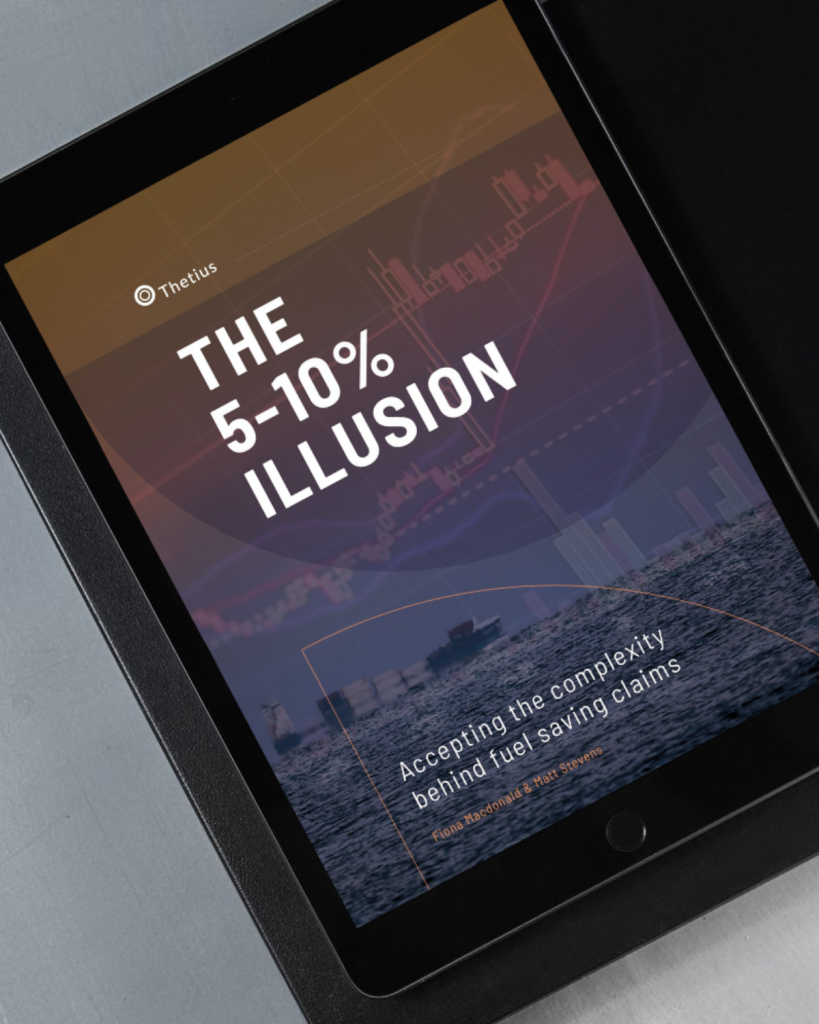
Download ‘The 5-10% Illusion’  and explore why the maritime industry’s reliance on unverified efficiency claims is eroding trust, and discover a framework to restore measurement discipline.
Tags: 5-10% Illusion
Previous Post

Precision in Motion: Bridging the efficiency gap through propulsion control automation

Next Post

Data Overload in Maritime: Why More Data Isn’t Better Decisions

Next Post
Data Overload in Maritime: Why More Data Isn’t Better Decisions

Data Overload in Maritime: Why More Data Isn’t Better Decisions

  • Client Login
  • Terms of Use
  • Privacy Policy

© 2026 Thetius is an Antares Digital Group Company

No Result
View All Result
  • Free Content
    • Free Newsletter
    • Free Reports
    • Free Webinars
  • Markets
    • By Industry
      • Ship Operations and Management
      • Chartering and Voyage Management
      • Port and Terminal Management
    • By Technology
      • Artificial Intelligence
      • Satellite Communications
      • Digital Platforms
      • Alternative Power Sources
      • Data and Analytics
      • Internet of Things
      • Carbon Capture and Storage Systems
      • Electronic Documentation
      • Robotics
      • Digital Twin
      • Cyber Security
      • Blockchain
      • Process Automation
      • Simulation
  • Research Services
    • IT Cost, Innovation, and Performance Benchmarking Club
    • Thought Leadership
    • Market Assessment
    • Customer Feedback
    • Competitor Analysis
    • Technology Strategy Workshops
    • Subscription Research
  • Upcoming Events
  • About us
    • About us
    • Careers
  • Get In Touch

© 2026 Thetius is an Antares Digital Group Company

We use cookies to ensure that we give you the best experience on our website. If you continue to use this site we will assume that you are happy with it.