
• My Account
    • Log In
    • This content is only available to Thetius subscribers 🔒
  • Contact Us
Thetius
  • Free Content
    • Free Newsletter
    • Free Reports
    • Free Webinars
  • Markets
    • By Industry
      • Ship Operations and Management
        • Maritime Autonomous Surface Ships (MASS)
        • Environmental Management (Vessels)
        • Technical Fleet Management
        • Vessel Performance Optimisation
        • Decarbonisation (Vessels)
      • Chartering and Voyage Management
        • Chartering and Commercial Operations
        • Voyage Management
        • Market Intelligence
        • Risk Management and Marine Insurance
        • Trade Facilitation
        • Emissions Monitoring and Reporting
      • Port and Terminal Management
        • Terminal Operating Systems
        • Environmental Management (Ports)
        • Port Cargo Handling
        • Environmental Management (Ports)
        • Asset Management (Ports)
        • Port Call Management
        • Decarbonisation (Ports)
    • By Technology
      • Artificial Intelligence
      • Satellite Communications
      • Digital Platforms
      • Alternative Power Sources
      • Data and Analytics
      • Internet of Things
      • Carbon Capture and Storage Systems
      • Electronic Documentation
      • Robotics
      • Digital Twin
      • Cyber Security
      • Blockchain
      • Process Automation
      • Simulation
  • Research Services
    • IT Cost, Innovation, and Performance Benchmarking Club
    • Thought Leadership
    • Market Assessment
    • Customer Feedback
    • Competitor Analysis
    • Technology Strategy Workshops
    • Subscription Research
  • Upcoming Events
  • About us
    • About us
    • Careers
  • Get In Touch
  • Free Content
    • Free Newsletter
    • Free Reports
    • Free Webinars
  • Markets
    • By Industry
      • Ship Operations and Management
        • Maritime Autonomous Surface Ships (MASS)
        • Environmental Management (Vessels)
        • Technical Fleet Management
        • Vessel Performance Optimisation
        • Decarbonisation (Vessels)
      • Chartering and Voyage Management
        • Chartering and Commercial Operations
        • Voyage Management
        • Market Intelligence
        • Risk Management and Marine Insurance
        • Trade Facilitation
        • Emissions Monitoring and Reporting
      • Port and Terminal Management
        • Terminal Operating Systems
        • Environmental Management (Ports)
        • Port Cargo Handling
        • Environmental Management (Ports)
        • Asset Management (Ports)
        • Port Call Management
        • Decarbonisation (Ports)
    • By Technology
      • Artificial Intelligence
      • Satellite Communications
      • Digital Platforms
      • Alternative Power Sources
      • Data and Analytics
      • Internet of Things
      • Carbon Capture and Storage Systems
      • Electronic Documentation
      • Robotics
      • Digital Twin
      • Cyber Security
      • Blockchain
      • Process Automation
      • Simulation
  • Research Services
    • IT Cost, Innovation, and Performance Benchmarking Club
    • Thought Leadership
    • Market Assessment
    • Customer Feedback
    • Competitor Analysis
    • Technology Strategy Workshops
    • Subscription Research
  • Upcoming Events
  • About us
    • About us
    • Careers
  • Get In Touch
Thetius
Thetius
No Result
View All Result

What the “5–10% Fuel Savings” Claim Really Means in Shipping

Matt Stevens by Matt Stevens
March 25, 2026
in Free Content
0
What the “5–10% Fuel Savings” Claim Really Means in Shipping

This insight examines what the “5–10% problem” actually means in practice. While small improvements in fuel efficiency can deliver significant cost and emissions benefits, demonstrating those improvements is far from simple. Ships operate in dynamic environments where weather, cargo loads, routing decisions and operational behaviour all influence fuel consumption, making it difficult to isolate the effect of a single efficiency technology.

The “5-10% problem” refers to the difficulty of accurately measuring and proving small efficiency gains in shipping operations, typically those in the range of 2-10%. While these may sound like small figures, when proven, the savings are huge, both in terms of cost savings and greenhouse gas (GHG) emissions reduction, and consequently, the return on investment (ROI) is already substantial.

Many technology providers claim that their solutions deliver between 5-10% in savings, but quantifying the gain is extremely complex. This is largely due to the fact that the tools and models to measure them aren’t precise enough to separate real savings from noise.

Our research has found that the critical issue with these stated claims is the absence of proof. Most of the time, performance claims are stated without clear scientific evidence or independent verification. Interviews revealed that vendors often draw on a one-off trial or modelling scenario to claim that their solution can offer “up to 10% in fuel savings.” But pilots are often short, vendor-controlled, conducted under limited operating conditions, and rarely documented. They seldom use long-term, fleet-wide data provided by third parties, leaving buyers struggling to decipher between genuine performance improvements and inflated claims.

Over time, this difficulty in separating real results from hype has eroded trust. The 5-10% claim has become a red flag for many owners. Instead of accelerating adoption of new technologies, unverified 5-10% claims have fueled skepticism, slowed investment, and even undermined the industry’s drive toward decarbonisation.

According to Jean Cristofari, CEO & Co-Founder of Spinergie, the 5-10% range often cited in press releases and maritime news articles has become the de facto benchmark vendor quote.

Hearing 5-10% fuel savings so often without solid proof has led to a credibility gap. As a result, instead of accelerating the adoption of new technologies, these claims fuel scepticism, slow investment, and undermine the industry’s collective drive towards decarbonisation.

This erosion of credibility is what we call the 5–10% problem.

Several major factors drive the 5-10% problem. These include commercial and market incentives, behavioural and cultural factors, complex systems that make verifying savings difficult, and weak and inconsistently applied standards.

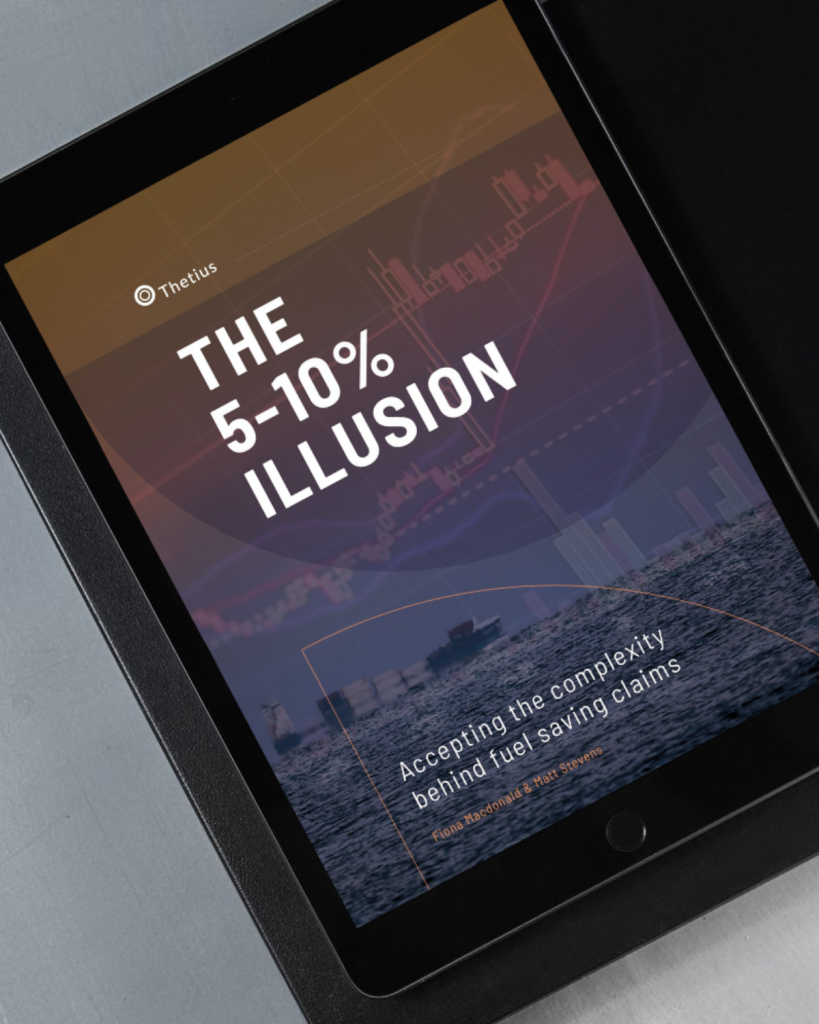
Download ‘The 5-10% Illusion’  and explore why the maritime industry’s reliance on unverified efficiency claims is eroding trust, and discover a framework to restore measurement discipline.
Tags: 5-10% Illusion
Previous Post

Operational Risk, Stakeholder Misalignment, and Accidental Vendor Lock-In

Next Post

Explainable AI and Balanced Interaction in Practice

Next Post
Explainable AI and Balanced Interaction in Practice

Explainable AI and Balanced Interaction in Practice

  • Client Login
  • Terms of Use
  • Privacy Policy

© 2026 Thetius is an Antares Digital Group Company

No Result
View All Result
  • Free Content
    • Free Newsletter
    • Free Reports
    • Free Webinars
  • Markets
    • By Industry
      • Ship Operations and Management
      • Chartering and Voyage Management
      • Port and Terminal Management
    • By Technology
      • Artificial Intelligence
      • Satellite Communications
      • Digital Platforms
      • Alternative Power Sources
      • Data and Analytics
      • Internet of Things
      • Carbon Capture and Storage Systems
      • Electronic Documentation
      • Robotics
      • Digital Twin
      • Cyber Security
      • Blockchain
      • Process Automation
      • Simulation
  • Research Services
    • IT Cost, Innovation, and Performance Benchmarking Club
    • Thought Leadership
    • Market Assessment
    • Customer Feedback
    • Competitor Analysis
    • Technology Strategy Workshops
    • Subscription Research
  • Upcoming Events
  • About us
    • About us
    • Careers
  • Get In Touch

© 2026 Thetius is an Antares Digital Group Company

We use cookies to ensure that we give you the best experience on our website. If you continue to use this site we will assume that you are happy with it.